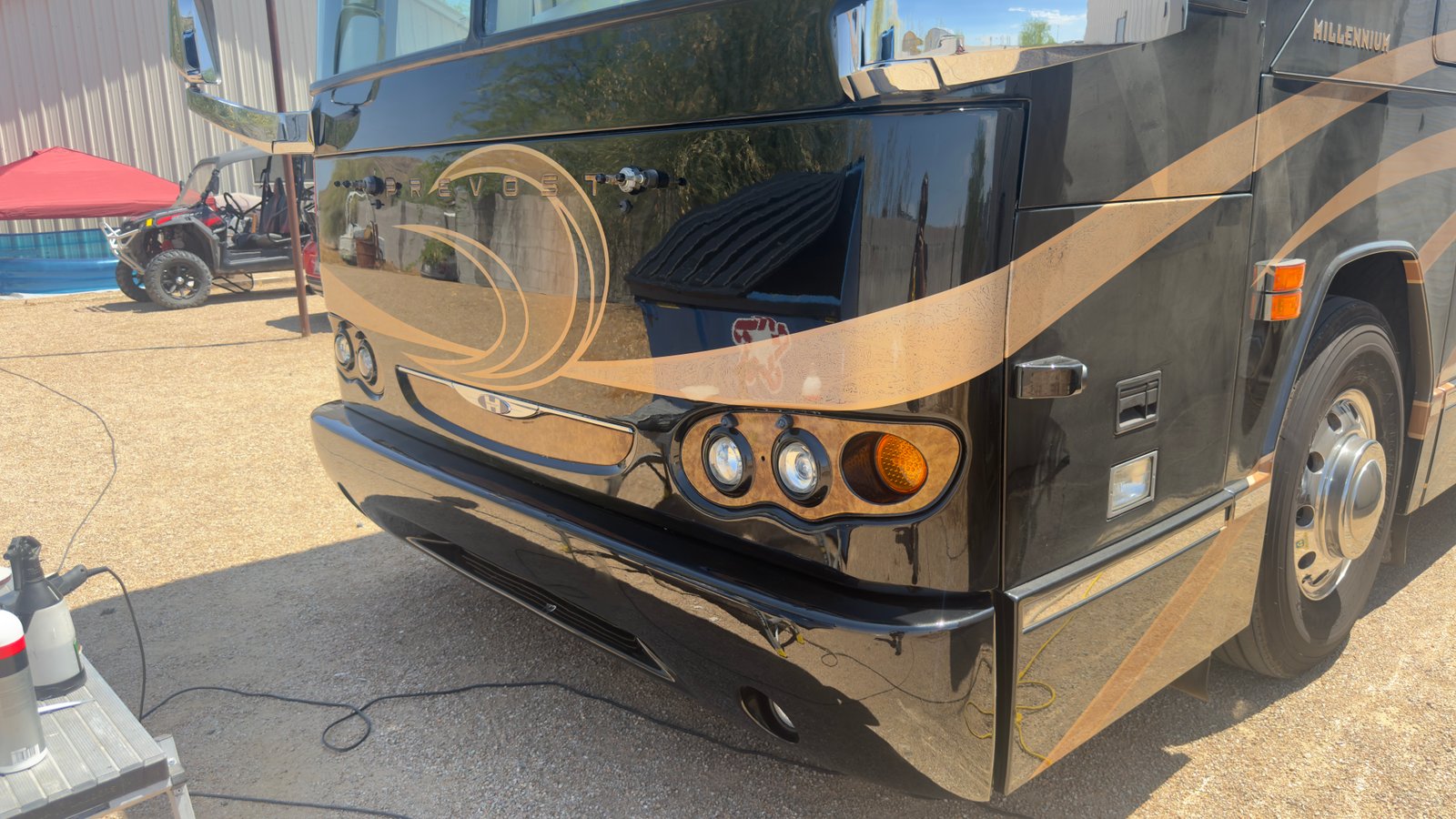
Arizona sun is harder on a coach than on a car — more surface area, more time parked, and fiberglass that chalks once it starts. We use an RV-specific formula, not the product that goes on car paint. Travel trailers through to Prevost coaches, all handled in-house.
On a phone? Text a photo of your rig to (480) 203-1596 for a fast assessment.
Water runs straight down a coated panel instead of clinging to it, and look at the lower half while it does — the yard is reflecting back off the paint. That's a surface flat enough to mirror what's in front of it, on something that lives outdoors year round.
On a coach that's the difference between an afternoon and twenty minutes. For most owners it's the benefit they notice long before they think about UV.
It also means less time with a brush against the gel coat, which is where swirls come from in the first place. The easier a rig is to clean, the better it keeps looking.

A Brinkley fifth wheel, finished and back on the road. White gel coat with black graphics is about the hardest combination to keep looking right in Arizona — the white chalks, the black fades, and the line between them shows every bit of it.
Coated, it washes down in a fraction of the time and holds that finish for years instead of months. Same process, same hands, whether it's this or a coach.
Quote my rigTravel trailers, Class Cs and toy haulers are the bread and butter here — family rigs that spend most of the year parked in Arizona sun. Size, surfaces and condition all change the approach, so nothing is a fixed package.
The biggest surface area we handle. Even coverage across every panel is the whole challenge, and it's why these take the longest.
Compact conversions with mixed materials — each surface gets the product suited to it rather than one coating across everything.
Mid-size, including cab-over designs. The overhang and its leading edge get particular attention since that's where debris lands.
Towables of every size. The front of a trailer takes everything the tow vehicle throws back at it, which is why film matters here.
Rear garage areas and heavy-duty surfaces that see more abuse than the rest of the rig. Treated accordingly.
Prevost coaches are regular work here. Conversions and one-off builds are all different, so each gets looked at properly before we recommend anything.

Black and deep reds show everything — swirls, water spots, the faintest oxidation. On a car that's a manageable surface. On forty feet of coach it's a different scale of work, and it's where the difference between a proper job and a quick one is most obvious.
More surface, more prep, more time. That's why we quote a coach after seeing it rather than off a price list, and why we'd rather tell you it needs correction first than coat over what's already there.

Most weeks it's travel trailers and motorhomes. Some weeks it's a Prevost — the top of the motorcoach world, touring buses and vehicles worth more than most houses. Full frontal PPF across the front cap, lower panels and leading edges is work we do routinely, not once.
Coaches reach us from well outside Arizona — California and further afield — because the people running them would rather move the bus than hand it to whoever is nearest. Your travel trailer gets the same process and the same hands.
Everything gets prepped, measured and installed in a climate-controlled shop by someone who has done it on rigs like yours before. Not in a lot, not in a driveway, not with a clock running.
Quote my coachCeramic handles what the sun and chemicals do. Film handles what the highway does. Which you need depends on how much you tow and where the rig sits when you're not using it.
RV-specific ceramic across the full exterior. UV and oxidation protection, dramatically easier washing, and a hydrophobic surface that sheds road grime instead of holding it.
Coats fiberglass, aluminum, and vinyl graphics — the graphics matter, since those are usually first to fade out here.
10-mil PPF on the front cap and impact zones, ceramic coating across the entire coach. Physical damage and sun damage are different problems and this covers both.
What we'd do to our own rig, and what typically goes on the coaches.
Heavy 10-mil film on the front cap, bumper, corners, lower skirt, and headlights and mirrors on motorhomes. GSWF Defender Platinum with a lifetime warranty, or Lockdown Layer at eight years.
Applies equally to motorhomes, travel trailers and enclosed trailers.
Car film runs 7.5 to 8.5 mil. On an RV we use 10-mil, and that's deliberate. A front cap at highway speed takes a beating a car bumper never sees — more frontal area, more time on the interstate, and everything the vehicle in front kicks up.
Thicker film absorbs more impact and holds up longer on exactly the surfaces that take the punishment. It's harder to install and it costs more. It's also the only sensible spec for a coach.
RVs face a different set of problems than cars, mostly because of how much of the year they spend sitting still in the sun.
UV breaks down the gel coat and the surface goes dull and powdery. Once oxidation sets in properly it takes compounding and polishing to reverse — which costs considerably more than coating it beforehand.
Vinyl decals are usually the first thing to go on an unprotected RV out here, often within a few years. Ceramic bonds over them and adds a UV-resistant layer.
Road grime, bug splatter and hard-water spotting bond hard to unprotected surfaces — and there's a lot of surface. A coated rig rinses in a fraction of the time.
A coach with clean, protected panels holds value noticeably better than one that's chalked and faded. Buyers read a dull front cap as neglect whether or not it is.
Two to five days depending on size and condition. A Class A takes considerably longer than a camper van, and we'd rather tell you that upfront than rush it.
Size, surface materials, current condition and how you use the rig. Then an honest recommendation — including when film alone is enough and you don't need the combo.
Thorough clean and decontamination across every exterior surface, with the right treatment for fiberglass, aluminum and vinyl rather than one approach for all three.
Surfaces prepared for proper adhesion. If oxidation is present it gets addressed here — coating over chalked gel coat is money wasted and we won't do it.
Windows, vents, seals and sensitive areas masked off so application lands exactly where it should and nowhere else.
Coating applied evenly across the exterior using techniques meant for large panels and mixed materials. Film cut and fitted to the front cap and impact zones.
Full walk-round to confirm coverage and finish before the rig goes back to you, along with the care instructions that keep it performing.
Two to five days depending on size and condition. A large Class A takes considerably longer than a compact camper van. We don't compress it — proper prep and application across that much surface takes the time it takes.
Both are 10-mil on RVs. Lockdown Layer is our in-house film with an 8-year warranty and strong value. GSWF Defender Platinum is the premium option with a lifetime manufacturer warranty covering yellowing, staining, cracking, blistering and delamination. On a high-value coach most owners choose GSWF; on a travel trailer Lockdown Layer is often the smarter spend. We'll tell you which we'd pick for your rig.
Yes. Ceramic bonds safely to vinyl graphics and adds a UV-resistant layer that slows fading and cracking. Worth doing in Arizona specifically — graphics on unprotected RVs out here often fade within a few years.
More so, not less. An RV parked uncovered takes constant UV, big temperature swings and everything the dust storms carry. That's the rig that benefits most. Storage still matters — one under a roof will outlast one in the open regardless of what's on it.
Yes, but the oxidation gets addressed first during prep. Depending on how far it's gone that adds time and cost to the job — and it's not optional, because coating over chalked gel coat locks the problem in. We'll assess it at your free consultation and be straight about what it needs.
RV ceramic carries a longevity expectation of five to seven years rather than a formal warranty, and how the rig is stored moves that number more than anything else. The film is different — it carries the manufacturer warranty that comes with it, lifetime on GSWF or eight years on Lockdown Layer. Full detail on our warranty page.
Regular washing with pH-neutral soap is essentially it. The hydrophobic surface means it rinses far faster than an uncoated rig. We'll go through care instructions and product recommendations when you collect it.
Yes — active military, veterans, first responders and seniors all qualify. Mention it when you get in touch and we'll build it into the quote.
Truck and boat owners rather than coach clients, for the reason above. Big painted surfaces, gel coat, sun — the same problems a rig has.
"Tyler does great work and is priced fairly. He has now polished and ceramic coated my boat as well as my truck. The difference is night and day. Highly recommend!"
Matt · Boat & truck
"Just had our Silverado and Traverse ceramic coated. Both vehicles came out great. Thank you Tyler!"
Mike Galindo · Two vehicles
"He went above and beyond by removing hard-to-reach parts to guarantee full coverage. Their attention to detail, professionalism, and customer service are top-notch."
Richard Perry
An RV quote isn't a price list. A 22-foot travel trailer and a 45-foot coach aren't the same job, and two identical rigs in different condition aren't either. Here's what actually moves the number, so you know what we're looking at when we quote.
Surface area is the biggest single factor. A Class A has several times the panel area of a camper van, and every square foot gets prepped and coated by hand.
The one that surprises people. A rig with real oxidation needs compounding and polishing before anything goes on, and that can add more time than the coating itself.
Front cap only, or front cap plus corners, skirt and mirrors. And which film — Lockdown Layer or GSWF — since the warranty difference carries a cost difference.
The combo costs more up front and is usually the better value over the life of the rig, but it isn't always the right call. We'll tell you when it isn't.
A few photos — front cap, a side, and anywhere you're worried about — is usually enough for a solid estimate before you drive out. If it needs eyes on it, we'll say so rather than guess.
Entertainer coaches and touring buses arrive from California and beyond. When a bus is the working asset of a tour, whoever runs it isn't picking a shop by distance — they're picking one that has done the work before and will still be standing behind it next season.
You won't find coach owners' names on this page. The people who send us buses are private about it, and we keep it that way — no names, no plate numbers, nothing posted without asking first. If that matters to you, it's part of why they come back.
If you're coordinating from out of state, get in touch before you route the bus. We'll talk through scope, timing and how long we'll need it, so nothing about the schedule is a surprise once it's here.
Motorhomes, travel trailers and toy haulers driven in from across the East Valley and Pinal County.
No fixed number, because every rig is different — but if you serve, have served, or you're a senior, we'll make sure you're taken care of. Mention it when you reach out.
Pricing depends entirely on size and condition, so every quote is custom. Send a photo and we'll get you a real number.