Most ceramic coatings are made for car paint. Gel coat and fiberglass are a different material facing a different problem — Arizona sun, mineral-heavy lake water, and months parked on a trailer between trips. Undrdog is built for that, and Tyler is hands-on with every one. Bass boats, pontoons and six-figure wake boats all go through the same process.
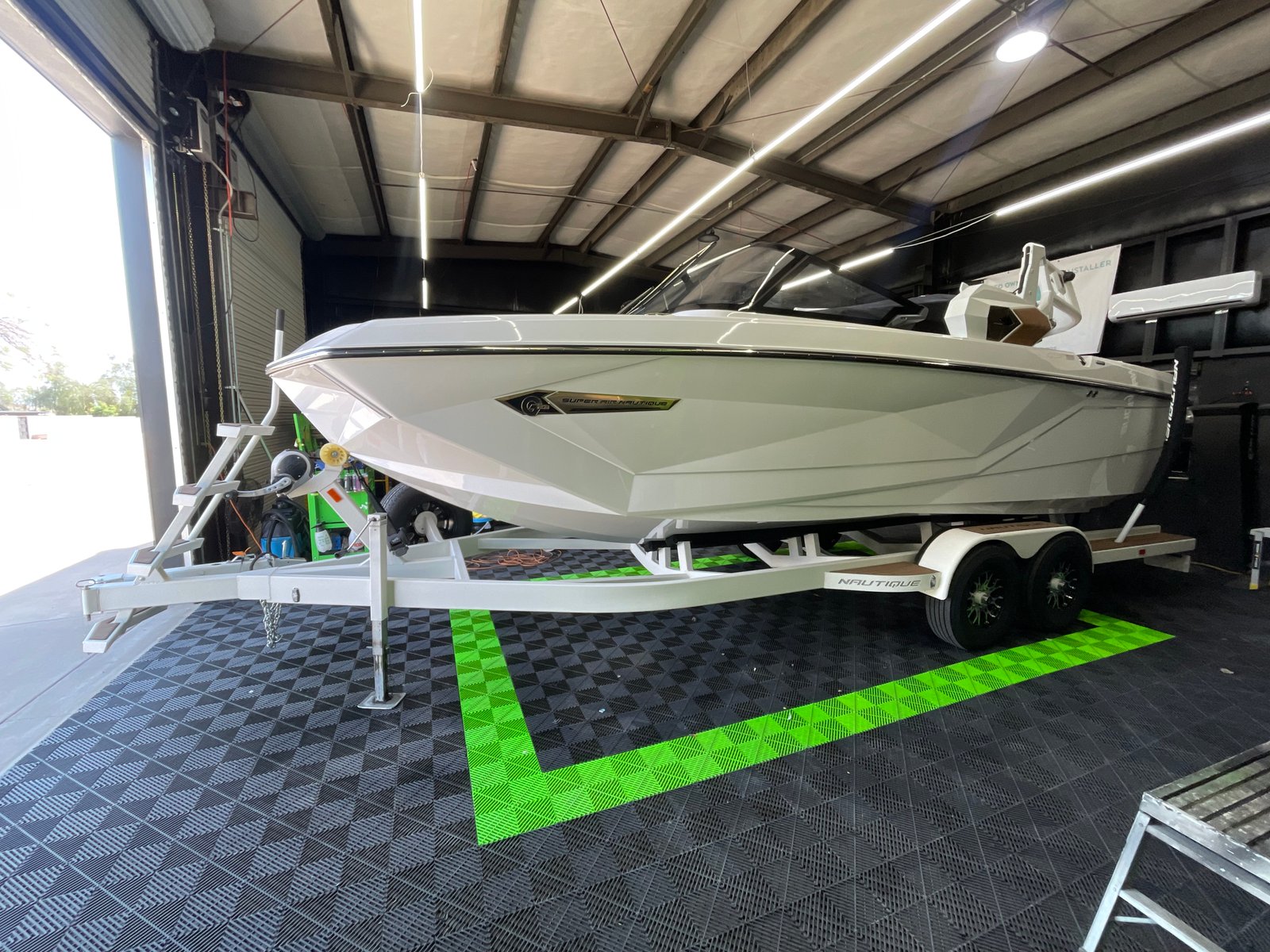
Both boats pictured here are our own work and both are six-figure hulls — but most of what comes through the shop is an ordinary boat, and gets the same process.
On a phone? Text a photo of your boat to (480) 203-1596 for an honest assessment before you tow it out.
That's a coated hull being rinsed — no mitt, no bucket, no scrubbing. Water pushes the lake off the gel coat on its own, and what's left behind is a surface reflecting trees and concrete back at you.
Coated gel coat sheds water rather than holding it, so lake scum and mineral deposits come off with a hose instead of a bucket and an hour.
It matters more than it sounds. The faster the after-trip rinse is, the more likely it actually happens — and a hull that gets rinsed every time is one that stays looking right.
Less contact also means fewer marks. Every pass with a brush on gel coat leaves something behind, so a surface that lets go of dirt by itself is protecting the finish twice over.
Undrdog is a marine-specific coating, not an automotive product with a boat label on it. It's formulated for gel coat, fiberglass and aluminum, and for what mineral-rich water and constant UV actually do to those surfaces.
We tried several marine coatings before settling on it. In Arizona conditions it beaded better, held up longer under UV, and stayed easier to clean. That's the whole reason it's what goes on your boat — not a distributor deal, not whatever was cheapest to stock.
Boats here face a combination you don't get in many places: brutal UV, hard water, and long stretches sitting still in the sun.
Arizona UV is among the strongest in the country. Gel coat fades, then chalks, then oxidizes — and it happens faster here than almost anywhere. A coating adds a UV-resistant layer that slows all of it considerably.
Pleasant, Havasu, Saguaro and Canyon all carry heavy mineral content. On unprotected gel coat that dries into deposits that take real work to remove. A slick coated surface sheds water instead of holding it.
Traditional wax breaks down within months under this heat and UV, so you're reapplying constantly. Coating lasts years — more time on the water and less in the driveway.
Once gel coat has properly oxidized, restoring it means compounding and polishing — considerably more expensive than coating it beforehand. Prevention is the cheaper end of this.

That's the part people underestimate. A trailered boat takes UV the whole time it's parked, then road grime, bugs and debris every time you tow it. Both of those are exactly what a coating handles.
It also changes the after-trip routine. A coated hull rinses down in a fraction of the time, which matters when you're backing into the driveway at eight on a Sunday evening.
Boats come in on the trailer and go out on the trailer. Everything happens inside — no work in the yard, no gel coat curing in the sun.
Request a quote
Gel coat gets the attention, but on a wake boat it's the interior that dates first. Light upholstery picks up sunscreen, body oils and dye transfer from boardshorts, and Arizona sun works on vinyl the entire time the cover's off.
Decking, seating and vinyl surfaces get cleaned and treated as part of the job, so the boat looks finished rather than half-done. Ask at your assessment what makes sense for yours — a two-year-old interior needs something different from a ten-year-old one.

Flake and metallic gel coat only read properly when the surface is clean and flat. Chalked or spotted, that blue goes grey and the depth disappears — which is why owners of boats like this notice a coating faster than anyone.
Nothing exotic about this job. Wake boat, trailer, in and out of the shop. It's the kind of work that fills most of the calendar.
Request a quoteBass boats, pontoons and family runabouts fill most of the calendar. Size, surfaces and condition change the approach, so everything gets assessed on its own rather than dropped into a package.
Wake boats, ski boats and sport hulls. Usually the ones owners care most about keeping showroom-fresh, and the ones where a coating shows most.
Bass boats, center consoles and aluminum hulls that see hard use. Durability matters more than shine here, and the coating delivers on both.
Aluminum tube treatment plus deck surfaces. Two very different materials on one boat, each handled with what suits it.
Jet skis and PWCs get the same Undrdog formula. Small surface area, heavy use, and usually the boat that gets rinsed least carefully.
Large gel coat surface area. More prep, more coating, more time — and the vessels where oxidation is most expensive to let happen.
Anything unusual gets looked at before we quote it. Send a photo and we'll tell you honestly whether it's worth doing.
Timeline depends entirely on size and condition. These are honest ranges, including prep, correction, coating and cure.
We look at the gel coat condition and talk through what you want out of it. If oxidation needs addressing first, you'll hear that upfront rather than on the invoice.
Bring it in at your appointment. From there it's full decontamination, surface prep and any correction the gel coat needs before anything gets applied.
Tyler applies the Undrdog himself. Not handed off to a stranger, not rushed to fit another job in behind it.
Collect it and go use it. We'll walk you through aftercare so the coating actually lasts the years it should.
Personal watercraft 1–2 days. Boats up to 20ft, 2–3 days. Twenty to thirty feet, 3–5 days. Over thirty, five days and up. Heavy oxidation adds to all of these, and we'll tell you before you commit rather than after.
"Had our 17 Supreme detailed and ceramic coated by Tyler and it turned out amazing. Dude does awesome work, very detailed and takes pride in his work. Shines like a brand new boat! Go see him!!"
Josiah Kivin · 17 Supreme
"Tyler does great work and is priced fairly. He has now polished and ceramic coated my boat as well as my truck. The difference is night and day. Highly recommend!"
Matt · Boat & truck
A jet ski and a thirty-foot cruiser aren't the same job, and two identical hulls in different condition aren't either. Here's what actually moves the number.
The obvious one. Every square foot of gel coat gets prepped and coated by hand, so a larger hull is straightforwardly more work.
The one that surprises people. Chalked or oxidized gel coat needs compounding and polishing first, and on a neglected hull that can take longer than the coating itself.
Hull and topsides, or everything including tubes, decks and hardware. Pontoons in particular vary a lot depending on how far you want to go.
A two-year-old boat that's been kept covered is a different job from a ten-year-old hull that's lived outside. We quote what's in front of us.
A few photos — hull side, transom, and anywhere it looks chalky — usually gets you a solid estimate. If it needs eyes on it we'll say so rather than guess at a number.
Most ceramic coatings are designed for automotive paint. Gel coat, fiberglass and aluminum behave differently and face different conditions. Undrdog is formulated specifically for marine surfaces. We tested several options before settling on it — in Arizona conditions it held up better under UV and stayed easier to clean.
Five to seven years for most customers with proper care. How often the boat is used, whether it's stored covered, and how it's rinsed after trips all move that number — more than the product does. It's a longevity expectation rather than a formal warranty, and we're straight about that on our warranty page.
Yes, and arguably more than a slipped boat. A trailered hull takes UV the entire time it's parked, plus road grime, bugs and debris every tow. Coating handles both, and it turns the after-trip wash into a rinse rather than a scrub.
Yes, but the oxidation gets corrected first — polishing and compounding during prep. Depending on how far it's gone that adds time and cost, and it isn't optional. Coating over chalked gel coat seals the problem in and wastes your money, so we won't do it.
Personal watercraft 1–2 days. Boats up to 20ft, 2–3 days. Twenty to thirty feet, 3–5 days. Over thirty feet, five days and up. That includes prep, correction, coating and cure time. Heavy oxidation adds to it, and we'll tell you at the assessment.
Yes — aluminum tubes and deck surfaces both. They're different materials so they get treated differently, and how far you go on a pontoon is one of the bigger variables in the quote. Worth discussing at the assessment.
Rinse after every use — that's most of it. When you wash, use pH-neutral soap and skip abrasive brushes. The coating means scum and grime mostly rinse rather than needing scrubbing. We'll go through full aftercare when you collect it.
Based in San Tan Valley, with boats towed in from across the East Valley and Pinal County on the way to and from the lakes.
No fixed number, because every boat is different — but if you serve or have served, we'll make sure you're taken care of. Mention it when you reach out.
Tyler will tell you honestly what it needs — including when a polish is enough and a coating would be overkill.