Including the answers that cost us work. If a coating won't do what you're hoping, or the cheaper option is the right one for your vehicle, you'll find that here rather than at the counter.
It depends on the package. Essential runs two to three years, Premium five to seven, Elite seven-plus, in Arizona conditions with proper maintenance. Separately, Cerakote coatings carry a five-year warranty and you get a physical warranty card at pickup.
No, and any shop telling you otherwise isn't being straight with you. Ceramic handles UV, chemical etching, water spotting and light wash swirls. Stopping a rock chip needs paint protection film. Film on the impact zones with coating over everything is the combination most people end up wanting.
Sedans start at $1,200, SUVs and vans at $1,500, trucks at $1,500 and motorcycles at $550. Final price depends on size, paint condition and package. Paint thickness measurement, decontamination, clay and multi-stage correction are included in every package rather than charged separately.
Usually yes. New vehicles pick up rail dust and industrial fallout in transport that embeds in the paint. You can't see it, but coat over it and the ceramic never bonds properly — so you've paid for years of protection and won't get them.
Yes — leather, vinyl and interior plastics, starting at $350. Arizona sun dries and cracks leather, and once it's gone you're looking at reupholstery rather than repair. The coating blocks UV, repels spills and body oils, and makes surfaces wipe clean. Add it to any package or book it on its own. Note this is protection rather than cleaning — if the inside needs a deep clean, that's interior detailing from $250.
In this climate, yes. Wax breaks down within weeks under Arizona UV and heat, so you're reapplying constantly. A coating lasts years and makes the car far easier to keep clean. Higher up front, not close on time or protection.
No. Reduced beading is normal as a coating ages and doesn't mean it's stopped working — the UV and chemical protection are still doing their job. A ceramic maintenance spray brings the beading back. Blue Line Shine is ours, made for exactly that.
Yes — tank, fairings, fenders, plus chrome and polished metal on request. Bikes take longer than the surface area suggests, because every panel is visible from every angle and proper coverage often means removing parts to reach behind them. Usually one to two days.
Usually not. Correction is how we deal with an older finish — swirls, light scratches and oxidation often come out. We measure the clear coat first to see what there is to work with, and we'll tell you honestly if a panel has been polished too thin to correct safely.
Lockdown Layer is our in-house film with an 8-year warranty — the same protection without the big-name marketing in the price. GSWF Defender Platinum is the premium clear option: self-healing, hydrophobic, up to 45% gloss enhancement, lifetime manufacturer warranty, in gloss or satin. SVG is colored film for color changes, 10-year warranty.
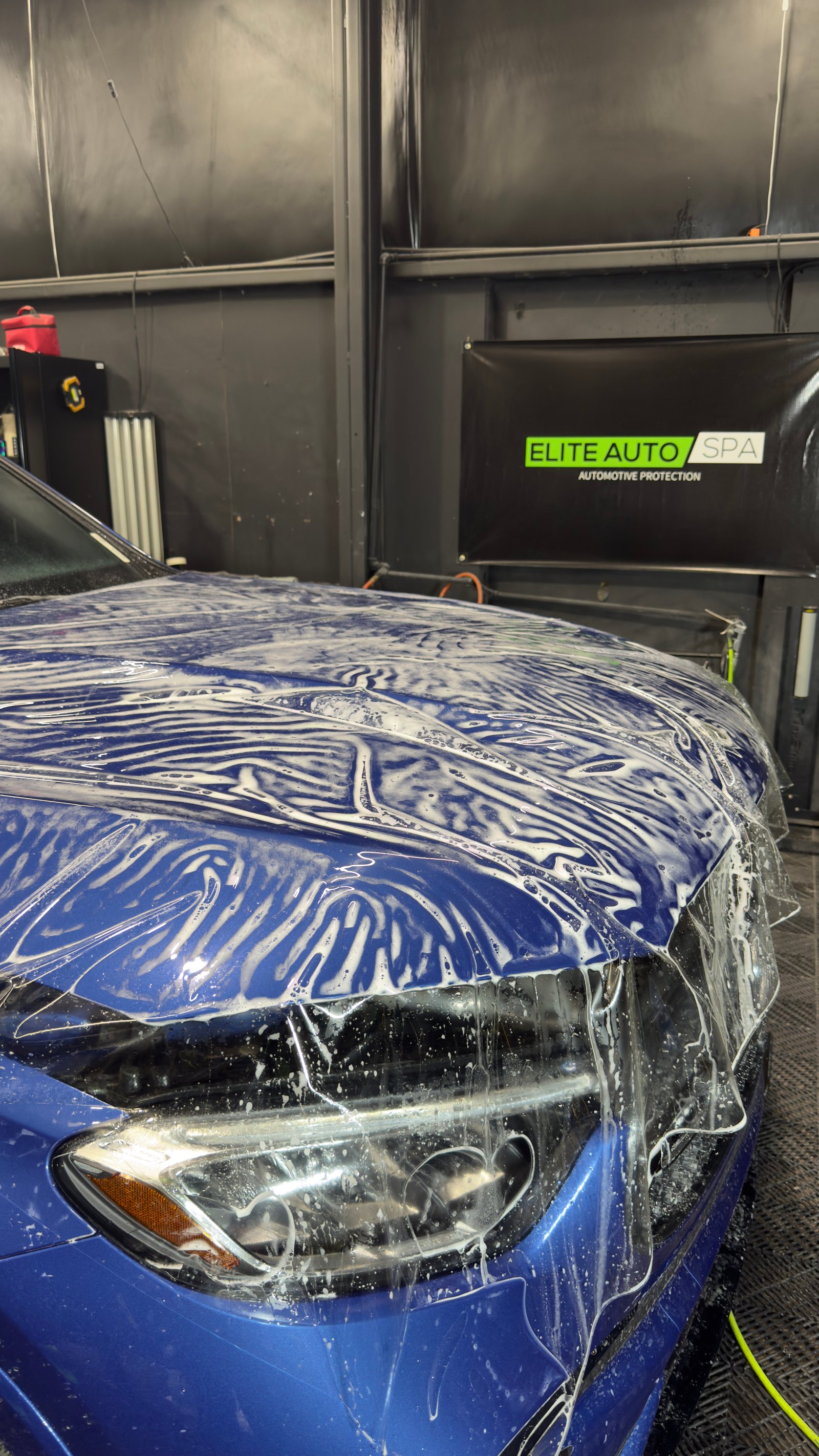
No — this is the one that catches people out. Film warranties cover manufacturing defects: yellowing, cracking, blistering, delamination. Not impact. If a rock gouges your film, that's the film doing its job, not failing. Replacing a section is normal service and far better than a repaint. Standard across every PPF brand.
Yes, using SVG colored film. It's paint protection film rather than vinyl wrap, so you get the new color and real rock chip protection in one layer, with factory paint sealed underneath. It peels off clean when you want the original back — no respray, nothing on Carfax. Ten-year warranty.
Sometimes, and anyone promising none on a full wrap isn't being straight with you. Computer-cut patterns and edge-wrapping minimize them. In hard sun at certain angles, particularly on darker paint, you may catch a film edge. Day to day, most people never notice.
No. Film prevents damage, it doesn't repair it. Once paint is chipped through the clear coat the only fix is a repaint — and a repaint shows on Carfax as non-factory paint, which affects resale directly. That's the argument for doing it before rather than after.
Most installs finish within one to two days. Drop off at your appointment, pick up when it's ready, drive it home the same day. Skip the first wash for seven days while everything cures.
Interior only from $250 — the inside done properly when the exterior is fine. Carpet shampooing is an add-on at this level. Full detail from $350 — inside and out, the one most people book. For-sale refresh from $550 — everything in the full detail plus trim restoration, engine bay shine and machine wax. All are starting prices.
No, deliberately. You don't come to a detail shop for a wipe-down — you can get that at the car wash. You come here for the equipment and the experience. Almost everyone who asks for an express detail actually needs a full one, and a quick wash over embedded dirt disappoints by the weekend.
We used to — we ran a top-of-the-line mobile rig, so this is experience rather than opinion. Mobile is great for weekly maintenance and we'd still recommend it for that. It can't do a full detail properly: limited power off a generator, 110-degree heat where products flash off before you've worked them, no bathroom or drainage, and the next stop always waiting.
Usually, yes — it's one of the few things you can spend a few hundred dollars on and reliably get back at sale. A car that photographs well and smells clean sells faster and holds its asking price. The for-sale refresh exists for exactly that.
Yes, both as add-ons. Pet hair removal $25–75 depending on how embedded it is. Ozone odor treatment $75–150, which eliminates smells at the molecular level rather than masking them. Let us know when you book so we can plan the time.
Yes. Tell us when you book and we adjust — pH-neutral products only, no aggressive scrubbing along film edges, no polishing that would cut into a coating. Regular detailing is one of the best ways to keep a coated vehicle performing properly.
There's a secure key drop box, so you can leave the vehicle before we open or after we close. Plenty of our first responder and trade customers use it. Just say so when you book.
More so, not less. An RV parked uncovered takes constant UV, big temperature swings and everything the dust storms carry. Fiberglass chalks quickly without protection, and reversing bad oxidation costs considerably more than preventing it.
Ten mil on RVs against 7.5–8.5 on cars. A front cap at highway speed takes a beating a car bumper never sees — more frontal area, more interstate miles, and everything the vehicle ahead kicks up. Thicker film absorbs more and lasts longer on those surfaces.
Regularly. Prevost coaches and entertainer buses come through, some from out of state. Full frontal PPF across the front cap, lower panels and leading edges is routine work here. We don't post owners' names — the people who send us buses are private about it and we keep it that way.
Most ceramic coatings are made for automotive paint. Gel coat, fiberglass and aluminum behave differently and face different conditions. Undrdog is marine-specific. We tested several before settling on it — in Arizona conditions it held up better under UV and stayed easier to clean.
Yes, but oxidation gets corrected first through compounding and polishing during prep. Depending on how far it's gone that adds time and cost, and it isn't optional. Coating over chalked gel coat seals the problem in.
Those carry a longevity expectation of five to seven years rather than a formal warranty, and storage moves that number more than anything else. RV film is different — it carries the manufacturer warranty that comes with it, lifetime on GSWF or eight years on Lockdown Layer. Full detail on our warranty page.
Unlike wax, which melts and breaks down in summer heat, ceramic coating is heat-stable and performs well at high temperatures. The UV here is the main reason coating makes sense — it adds a UV-resistant barrier that slows fade, chalking and oxidation considerably.
More than almost anywhere. I-10, US-60, the 202 and the 101 all carry loose rock, and Arizona shoulders shed it constantly. Combine highway chips with dust storm abrasion and intense UV and you have close to ideal conditions for paint damage.
Every two to three weeks is a reasonable rule, more during dust storm season. The good news is a coated vehicle washes far faster — dust and dirt rinse off rather than needing scrubbing, so more frequent washing takes less total effort than you'd think.
Coating handles it well. Water beads and sheets off, which reduces spotting after monsoon rain, and the mud and debris left behind come off far more easily. Most coated owners notice the difference clearly during monsoon compared with previous years.
Cerakote and Gtechniq for ceramic coating, Undrdog for marine, GSWF Defender Platinum and SVG for film — plus authorized installer for Lockdown Layer. These represent formal manufacturer training rather than badges. See the certifications page.
Yes — active military, veterans, police, fire, EMS and seniors. As a former firefighter this isn't a marketing tactic for Tyler. We don't put a fixed number on it because every job is different, but if you serve or have served you'll be taken care of. Mention it when you reach out.
Cars, trucks, SUVs, motorcycles, RVs, travel trailers, enclosed trailers, coaches, boats and personal watercraft. Every vehicle gets the same attention regardless of what it's worth — a 2015 Honda gets treated the same as a Prevost.
30456 N. Varnum Road, San Tan Valley, AZ 85143. Monday to Friday 9:00 AM to 5:00 PM, weekends by appointment. Appointment only — call or text (480) 203-1596 or use the contact form.
Credit card, cash, Zelle and Venmo. Payment is due at pickup.
Yes — Front Line Chemicals, developed and shop-tested here. Six products from $15, all safe on coated paint and film. 911 Shine is donated to every Pinal County Sheriff's patrol car, and a portion of proceeds goes to Arizona K-9 units. See the products page.
Text a photo of your vehicle with the question and you'll get an honest answer — including when the answer is that you don't need what you're asking about.